Regardless of their age, the Maya women are the fighters of Guatemala, and will not let a corrupt government nor genocide eliminate their power. From these women, we can learn how sacred values manifest themselves in their quotidian. This ancestral connection is something unique to indigenous cultures across the Americas. They continue to utilize their ideologies, ones untainted by Western cultures, to possess the power to be activists and defend their rights in society. We learn that this indigenous fight is an eternal one that will continue to prove indestructible.
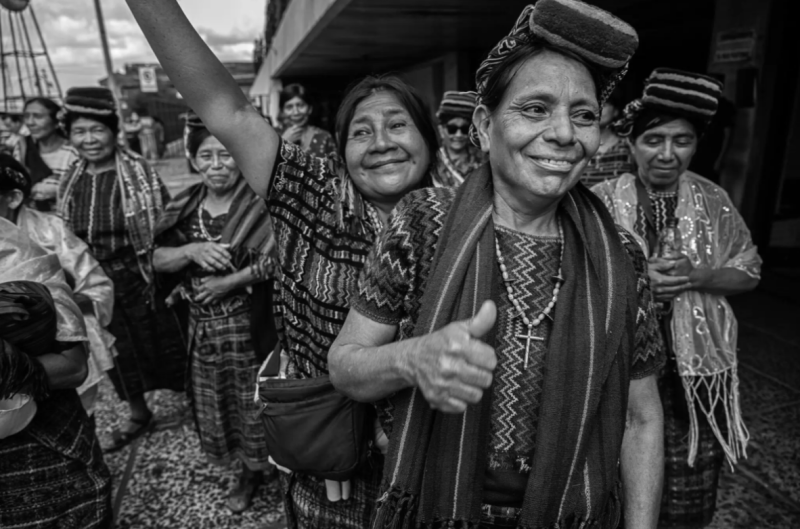
The women reacted after Guatemala's highest court announced a guilty verdict on
May 30. Victor J. Blue for The New York Times
Ik’ixoq, for lack of a perfect translation, is a Quiche-Maya word for strong woman. Ik, a sacred day in the Maya calendar, represents a strength. This strength lives in the breath of Huracan, the god of the wind. Also known as the heart of the sky, Huracan played an integral role in the creation of the world and some of the first people of the world, according to the Maya cosmovision. He created the trees and plants that give us oxygen and motivation, he helped create the wooden humans, which he later had to rid due to their inability to comprehend and communicate with the gods. Huracan was the wind, the rain, and the life for the Maya, preserving the evolution of life for both humans and nature alike. In Quiche-Maya, the prefix Ix, pronounced (ee-sh), signifies femininity. This means that all gods, words, and names with this prefix embody the traits of the woman. The moon, flowers, fertility, and health, for example, are all elements that are inherently feminine. Without possessive markers to become the word wife, the word ixoq translates to woman, as in an individual who is bound to no one, just herself.
In Guatemala, a nation rich with Indigenous cultures and vibrant communities, one of the most destructive, inhumane, and tragically underrecognized wars in modern history unfolded—one that disproportionately devastated the Maya community, especially Mayan women. Commencing in 1960, Guatemala’s government has proven to be corrupt and immoral, showcasing little to no care for its citizens. After a severe economic crash in the early 20th century, lower and middle classes of Guatemala were most severely affected. This led to the inequality and exploitation of workers, which penetrated throughout the country and resulted in high death rates among the Guatemalan. As the civil war continued, the political and moral climate deteriorated. Founded on biases and ignorance that the Maya were extreme leftists due to their desire for land redistribution and equal rights, the right-wing Guatemalan military, who were in absolute power, brutally massacred thousands of innocent Maya people, eliminating around 4% of Guatemala’s population of 10 million over a span of 36 years. Heinous war strategies targeted Maya women and girls, forcing them into sexual slavery and subjecting them to rape and molestation. The women who come from a culture that celebrates the individuality and liberation of female sexuality endured the most painful and dehumanizing torture that has traumatized them since. This war is recent; these survivors still live today. They live with the memory of losing their sons and husbands, being left alone to take care of their families and find ways to survive. The intention behind targeting the Maya was to try and destroy the social fabric of their community completely. Although the effects were gruesome and left Guatemala as a whole irreversibly tainted, the government’s unethical genocide could not destroy the Maya due to their astute activism and eternal drive for justice. The Maya community is the victim of the Maya Genocide and must be at the forefront of any retelling of this history.
As Eduardo Galeano writes in his book Open Veins of Latin America, the commencement of the 20th century was the beginning of decades of war in Central America. Soon after the United States’ desire for Guatemalan exports lessened, the nation was in a severe crisis of economic strife, and many workers faced the depths of unemployment. Galeano’s report lacks how women were affected during this time. My work not only acknowledges the female perspective but also explores the intricacies of how these perspectives differ between the ethnic communities that make up Guatemala. Carol A. Smith’s work “Race-Class-Gender Ideology in Guatemala: Modern and Anti-Modern Forms”, presents the idea that Galeano forgets. Smith investigates race and class, but most notably, gender dysfunctions in Guatemalan society. Her emphasis on Maya ideas surrounding gender allows my work to investigate the ancestral origin of their ideas. Similarly, Victoria Sanford’s lively account of Guatemala’s civil war investigates first-hand accounts to also include the silenced Maya perspectives and how they exist today. She writes a detailed report on the war while also providing astute analysis of the effects of immorality. Sanford’s inclusion of several indigenous perspectives, like Smith’s, catalyzes my work to thoroughly explore the origins of these perspectives. Inspiringly historian Beatriz Manz does a phenomenal job at pushing the need for advocacy in her work, “The Continuum of Violence in Post-War Guatemala”. Intertwined in her exploration of the post-war oppressive fatigue within Guatemala is her acknowledgement of her privileged position to tell this history. Her work is commendable and serves as inspiration for my own work as a second-generation Latina. I, too, acknowledge my position and ensure that my research is nuanced and provides the perspective of the Mayan women whose unique experience of the war continues to inspire people around the world.
Although able to find some scholarship, it was difficult to identify work that captured the perspectives of Maya women, and this, I must say, is unsettling. This war ended in 1996. The survivors of this genocide still live among us today. As activists and academics, the goal should always be to illuminate the voices of the unheard and bring them to light with the intention of preservation. Although scholars such as Edward Galeano and Victoria Sanford have substantially advanced the research and understanding of Guatemalan history during the 20th century by explicitly bringing forth the brutal effects of a corrupt dictatorship, their analysis lacks an indigenous, female perspective. In this paper, I prove the importance of understanding the ostracized yet integral perspective and role of indigenous Maya women during and after the 36 year Civil War in Guatemala by composing ideas that create a more structured understanding of this Guatemalan history. Through close analysis, we will uncover how Maya women persevered through the war and sought justice by exploring their ancestral values and distinctly empowered gender roles in 20th century Guatemala.
In order to conduct a thorough analysis, we must commence with a historical overview of the 36 year civil war. As previously stated, the success of the war relied on the economic corruption and exploitation of the middle and low classes in the 1960s. In 1982-1983, de facto president José Efraín Ríos Montt was responsible for the most brutal and violent time in Guatemala ever. Although only ruling for two years, Montt directed the mass killing of the Maya communities in Zacapa and Izabal, Guatemala. As a former soldier in the Guatemalan army, his trajectory into power occurred through a military coup d’état that overthrew the previous president, Lucas García, on accusations of rigging votes and general corruption of the working class. Through his dictatorship, Ríos Montt enforced military power throughout the country in hopes of reforming political instability by fighting against Marxist leftist guerrillas. His plan was to eliminate these revolutionary groups, as they actively fought against his regime as a dictator. Naturally, many of the guerrillas were formed by and in support of indigenous communities because their need for land redistribution closely aligned with communist values. In 1982, Ríos Montt employed a “scorched earth” tactic to rid himself of any people who opposed him. Also known as the Mayan Genocide, Ríos Mott and exacerbated a civil war which led to a 3% decline in population over a span of 36 years.
As the dictatorships and government corruption continued, so did the brutal massacre. The government ordered for the extermination of Mayan communities by any means possible. The military enacted mass shootings and several forms of physical and psychological torture on the Mayans. Disturbingly, many of these murders were never officially recognized by the government, because it would be detrimental to their narrative. In hopes of not being classified as a genocide, the military would rid itself of Mayans, illicitly causing many disappearances. Thousands of indigenous bodies were disposed of, thrown into the ocean, or into large pits, and burned to eliminate any trace of murder. These malicious acts made it virtually impossible for family members of victims to receive proper cultural burials and death ceremonies. According to American historian Beatrice Manz, over a million people were displaced from their homes during the war. However, this number continues to grow as the effects of the genocide linger today, causing living in Guatemala to be a burden to be freed through migration to other countries (Manz 157). After twenty years into the war, the genocidal nature of Guatemala’s civil war began to attract the attention of international powers.
In 1985, Amnesty International, a global movement that fights for human rights worldwide, released a report on the murders of Guatemalan citizens Maria del Rosario Godoy Aldana de Cuevas, Augusto Rafael Cuevas Godoy, and Mynor Godoy Aldana. The two-page report establishes that Maria, vice president of the Grupo de Apoyo Mutuo por el Aparecimiento con Vida de Nuestros Esposos, Hijos, Padres, y Hermanos (GAM), was killed alongside her brother and two-year-old son. On their way to a pharmacy to buy medicine for the child, they were reportedly abducted and later found dead in a car just south of the capital, Guatemala City. As a 24-year-old sociology student attending the University of San Carlos and vice president of GAM, Maria, like many of the other members of GAM, had received death threats due to her work to fight against the disappearance of family members during the war. She herself lost her husband to a mysterious abduction that the police claimed to be a runaway situation conducted by her husband. This report, written by Amnesty International, fights against these disappearances by amplifying the unjust and emotional impacts of this war on families around the nation. GAM, established in 1984, is one of the many examples of how the victims of Guatemala’s corruption came together to fight against this genocide. Composed of both Guatemalan and Mayan communities, these organizations and revolutionary groups embody the powerful and strong characteristics of the Maya populations.
During the war, activism was not limited to group efforts, but also conducted by powerful individuals like activist Rigoberta Menchú. At the height of the Mayan Genocide, Menchú published one of the most famous Maya works of Guatemala, Me llamó Rigoberta Menchú y así me nació la conciencia, 1983. This autobiographical work tells the story of the genocide through the perspective of a Mayan woman. She details the violent effects of the corrupt government through first-hand experiences. Her work is filled with stories of community members and their personal accounts of losing family members to the hands of the nation. Translated and used across the world, Me llamó Rigoberta Menchú y así me nació la concencia is considered one of the most revolutionary indigenous works of the 20th century. As claimed by Professor of Anthropology Victoria Sanford in her work,
“From I, Rigoberta to the Commissioning of Truth: Maya Women and the Reshaping of Guatemalan History.”, “[Me llamó Rigoberta Menchú y así me nació la concencia] chronicles the life of Rigoberta’s family, which becomes the vehicle for the outsider (both non-Maya Guatemalans and the international community) to understand the struggle of the Maya in Guatemala to defend their lands, communities, and culture, in the face of ever-increasing state violence” (Sanford 17).
In producing this work and being a proactive force in her own and other communities about her history, Menchú resisted the stereotype of indigenous women. Rather than being “pawns of political progress” Mechú showcased the tenacity of the Maya women as agents of how their stories are told (17). Later in her work, Sanford compiles theories from other historians, claiming that this activism is an inherent characteristic of Maya communities around Guatemala. Many of these guerrilla groups were led by those—both indigenous and Latinx—who were unhappy with the state of the government and its unjust principles. A large number of these members were people who had direct experience with this corruption. Sanford includes the reason why Esperanza, a woman from the Kanjobal nation, joined the guerrillas; Esperanza recalls,
“The army arrived and kidnapped three teenage boys. They tortured them and they killed them right in the village. They cut out chunks of flesh and stabbed them many times…they had peeled off the soles of their feet so they couldn’t run…one of them was my cousin…I began to think… ‘I want a weapon and if I die, I want to die killing a soldier.’... I was fifteen years old” (33).
Sanford recalls another former guerrilla telling her that she, “didn’t know if my words have value, but I would like to tell you my story” (34). Mayan women are a prime example of how oppressed communities survive and persevere even when all odds are against them. These quotes showcase the heightened necessity of being heard after centuries of being silenced.The Maya are fighters, they always have been.
Like activism, Mayan standards of female sexual agency, an expression of the broader Mayan tradition of strength, are rooted in an intensified demand for Mayan recognition and acknowledgement. In Carol A. Smith’s work “Race-Class-Gender Ideology in Guatemala: Modern and Anti-Modern Forms”, she explores how gender roles in Guatemala exist today due to its roots in westernization and colonialism. Smith commences her analysis with a historical overview of Western “blood regimes”. During the late 17th and early 18th centuries, as western nations began to construct new societies and systems in the Americas, a new form of racism sprouted—one that was rooted in biology. In order to keep people of color in low class positions, White people would justify racism by claiming it to be objectively scientific and rooted in demonstrable ideas. Mostly used to distinguish power and status levels, people would be organized and treated based on their ethnic proximity to Whiteness. Based on this ideology, it was imperative to white people in power to maintain their “pure blood” by creating marital and political systems that strictly prohibited interracial relations (Smith). Smith then acknowledges how these exclusionary systems thrived on monogamy, enabling men to control women and their sexual and social freedoms. These methods, which fortified the destructiveness of enslavement and conquest, survived throughout centuries, still existing in Guatemala today.
Through her analysis on gender roles in Guatemala, Smith makes it clear that sexism and the limiting of a woman’s freedom plays out differently between Guatemalan and Mayan societies. Due to Westernization, it is common for Latino men to be victims of machismo, an aggressive feeling of masculine pride, that perpetually results in an infringed perception on Latina women. Machistas, therefore, believe that men are inherently better than women. Smith points out that in the midst of this superiority complex that lives throughout Latin America, men of all classes continue to see women, particular, but not limited to women of all classes, as sexual objects who are undeserving of structured, Western marriages or relationships with men or their own children, obstructing the a woman’s power. Conversely, Smith presents her findings on Maya communities and their understandings of women and their freedom in contrast to women in Occidental societies. Smith nods to other historians when she mentions that it was common for Mayan women to have several sexual partners, giving women a certain power and liberation that Guatemalan women living just miles away do not have. Smith writes that, “[Maya women] inherited their own land, usually had their own sources of income, and were relatively free to move about (in the community). Maya women, moreover, could seek divorce, mediation, or redress from the community if mistreated by their husbands” (739). This freedom, completely contradicts the chauvinist systems that have been used to keep women in Guatemala, and across all nations of Latin America, in powerless positions. But how is it possible that these Maya communities were able to evade the realization of these destructive ideologies in their communities? To this, I respond, it is possible because indigenous communities have taken on the responsibility, through force and autonomous decisions, to preserve their traditions. This liberty is rooted in the ancient text of the Quiche Maya, the Popol Vuh.
There is a particular story in the Popul Vuh that highlights the importance of success through limitless freedom, an ideology seen within several aspects of the Maya lifestyle. Rooted in the Popol Vuh is the idea that time moves cyclically, understanding death as a transition to regeneration.The story aforementioned is of two divine twins Hunahpu and Ixbalanqu who go through several journeys as they grow up. These twins were the offspring of their mortal mother Ixquic and divine father Hun Hunahpu. These twins, Hunahpu, the brother, and Ixbalanqué, the sister, were a mischievous pair who cunningly succeeded through many trials and tests forced upon them by the gods. They were fierce, tricky characters who found their way into and out of sticky situations; their sense of empowerment supported them to act based on liberty. During one of their adventures, Hunahpuh got his arm ripped off in a fight with Vucub Caquix, a character of arrogance and delusion. As the twins assess the situation, their immediate response is to find a way to reattach his arm. The twins disguised themselves as divine healers, to visit Vucub Caquix to heal the jaw that Hunahpuh had broken during their fight. After Vucub Caquix agreed to receive help, the disguised twins switched his teeth, which were composed of jewels, with corn, completely destroying Vucub Caquix’s power and beauty, causing him to die of shame. After this, the twins worked together to reattach Hunahpu’s arm, overjoyed from their success (Recinos). From this story, we learn the value of strategy, collaboration, and strong will power to reach goals. Just as the twins sought to repair the situation through skill and empowerment, so did the Maya during this genocide, by subconsciously practicing the values of their ancestors. It was impossible to completely wipe out a culture of people because they had already survived through centuries of violence and decadence. The story of Hunahpu and Ixbalanqué illustrate this, showing that the loss of a body part did not mean destruction, but posed the starting point for its reattachment. The Maya, a nation that lived for nearly 3,000 years before colonization, have endured it all and have found a way to continue. They survived through the Spanish conquest, capitalism, and Westernization. The Maya do not die, they survive, and continue fighting today.
After decades of fighting, a group of 36 Maya women finally got justice for being sexually assaulted during the war 40 years prior. “After Six Years of Reporting, Sharing a Story of Resilience” reads a New York Times article written by Sarah Bahr in August of 2025. This article shares the story of photojournalist Victor J. Blue and his journey following this group of inspiring Maya Achi women. After making connections with the women, they shared with Blue their experiences of being sexually assaulted by the military in the 1980s. This group of older women had been wronged by the nation for too long, so they sought out support from their community. According to Blue, the women went through Guatemala City trying to push their case forward to anyone who would help them. Blue recalls being, “‘floored by not only the crimes they had suffered through, but also their absolute determination to hunt for justice for what had been done to them’” (Bahr). Included in the article is one of Blue’s photos capturing the women reacting to Guatemala’s highest court announcing a guilty verdict. This emotional picture (included above) showcases the wave of feelings rushing through the women, finally seeing that they had reached their goal. Blue mentions that some of the women danced out of joy. These Maya Achi women, many of whom were well into their 70s, all came together to share their experiences and formulate a plan to get justice. After five years of collaborative hard work, these women single-handedly achieved justice from a system that was built on their exploitation. This story is one of many that capture the undying tenacity of the Maya women and their drive to fight for their rights, regardless of the time period.
The Maya women have persevered through centuries of violence and destruction to their homes and bodies. Starting in the early 1500s, when the Spanish began their conquest of Mayan lands, and continuing through the 20th and 21st centuries, women have continued to feel the effects of corrupt dictatorships. The women who fought against the military that supported the genocide of all indigenous peoples were seen as enemies to the state for fighting for their rights as people. They joined Marxist guerrilla groups as teenagers, accepting their death and choosing to die fighting. What the government failed to understand is that the reason they could never be successful in scorching the earth of all indigenous people, is that the Mayan fight is rooted in their ancient understanding of humanity. The Popol Vuh, the sacred text of the Quiche Maya showcases how the Maya practice resilience and liberation regardless of the circumstances. They are people who will achieve their goals by any means possible, because their survival directly affects the preservation of their culture. These characteristics flourish in the Maya women today. Regardless of their age, the Maya women are the fighters of Guatemala, and will not let a corrupt government nor genocide eliminate their power. From these women, we can learn how sacred values manifest themselves in their quotidian. This ancestral connection is something unique to indigenous cultures across the Americas. They continue to utilize their ideologies, ones untainted by Western cultures, to possess the power to be activists and defend their rights in society. We learn that this indigenous fight is an eternal one that will continue to prove indestructible.
In true Mesoamerican cyclical fashion, we will conclude with a path to the beginning. Please recall my encouragement from the introductory sentiments of this paper; perhaps a title like this is more sufficient: Autonomous woman, draped in the moonlight, white lilies of the land, embodiment of the howls of the wind and rain; woman of impenetrable mind and life: Illuminating the disposition of Mayan women in dictatorial Guatemala.
Works Cited
Bahr, Sarah. “After Six Years of Reporting, Sharing a Story of Resilience.” The New York Times, 10 August 2025, https://www.nytimes.com/2025/08/10/insider/guatemala-maya-achi-women-rape-case-trial.html. Accessed 12 November 2025.
Central America Special Action. Killing of María del Rosario Godoy de Cuevas, Augusto Rafael
Cuevas Godoy, and Mynor Godoy Aldana. Central America Special Action: Amnesty
International, 1985.
Frommer, Fred. “Efrain Rios Montt | Biography, Trial, & Facts.” Britannica, https://www.britannica.com/biography/Jose-Efrain-Rios-Montt. Accessed 12 November 2025.
Galeano, Eduardo. King Sugar and Other Agricultural Moncharchs. Open veins of Latin
America: Five Centuries of the Pillage of a Continent. Monthly Review Press, 1997.
59-133
Manz, Beatriz. “The Continuum of Violence in Post-War Guatemala.” Social Analysis: The
International Journal of Social and Cultural Practice, vol. 52, no. 2, 2008, pp. 151–64.
JSTOR, http://www.jstor.org/stable/23182402.
Meade, Teresa A. Revolution and Its Alternatives. A History of Modern Latin America: 1800 to the Present. 2nd ed West Sussex, United Kingdom: John Wiley & Sons, Inc., 2016. 287-317 2022.
Recinos, Adrián, translator. Popol Vuh. Fondo de Cultura Económica, 1960.
Sanford, Victoria. “From I, Rigoberta to the Commissioning of Truth: Maya Women and the
Reshaping of Guatemalan History.” Cultural Critique, no. 47, 2001, pp. 16–53. JSTOR,
http://www.jstor.org/stable/1354580.
Smith, Carol A. “Race-Class-Gender Ideology in Guatemala: Modern and Anti-Modern Forms.”
Comparative Studies in Society and History, vol. 37, no. 4, 1995, pp. 723–49. JSTOR,
http://www.jstor.org/stable/179207.
Add comment
Comments