The mere dichotomy between these two (of many) opinions showcases just how complicated one decolonial effort can be. Dahomey captures this effectively by incorporating long scenes of pure discussion. We see the faces that speak these ideas, the hands that created these objects, and the objects' spirits and how they impact the their diverse audiences. Although the film captures the “superficial” and immediate effects of one case of repatriation, it makes us think about the long-lasting effects of how museums try to decolonize. To me, the film says, if these are the conversations sprouting from repatriation at this moment, to what extent will they be in the next ten, fifty, or one hundred years? What is the future of museums, and how do we decolonize them properly and sensitively?
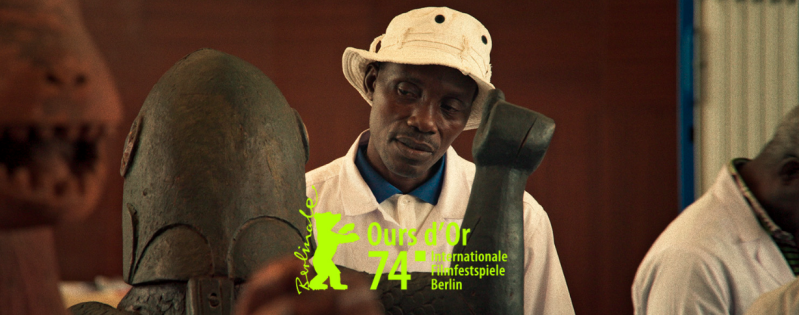
Still from Dahomey
Mati Diop
2024
All around the world, museums have the same function: to house art that tells different stories and histories. While some focus on one particular movement or moment in time, most museums share a similar goal to educate large audiences via visual learning. Although subtle, depending on the institution, education lies deeply in the foundation of art institutions. Every didactic—the curated text placed next to a certain work of art serving to interpret the piece—is there to enlighten us on the art and its position in the exhibit, but more importantly, in society. In these museums, often several different cultures are represented. Whether that be a renowned ancient Egyptian collection like that of the Metropolitan Museum of Art or a small, unexhibited African collection in the Brooklyn Museum, these institutions have dubious amounts of artwork that do not belong to the land that it currently inhabits. It is important to note the origins of these pieces and why these Western institutions have so many of them. According to a publication by the MOMAA, “African Art Repatriation & The New Museum Landscape”, art historians suggest that about 90-95% of African heritage currently resides outside of Africa. This art, but more accurately, history and culture, was stolen during the colonial periods in which Britain and other European countries invaded and ruled over African people. This same logic is applied to the indigenous peoples of the Americas, whose culture was also stolen with force in order to be exhibited in Western museums as foreign and exotic artifacts. Today, and for many decades, museums have worked to balance out this history by implementing initiatives and programming that offset and simultaneously bring awareness to their colonial history. One of the major initiatives that museums have only recently begun to implement after legal conversations is repatriation. The act of repatriating means to send stolen physical heritage from one country back to its original home. While repatriation started in the 1950s closely following World War II in order to protect culture stolen and destroyed by the Nazi party, the repatriation of art and property became widespread after the 1970 UNESCO Conference, which allowed for stolen objects to be seized with proof of ownership. Following this major event was the 1995 UNIDROIT Convention on Stolen or Illegally Exported Cultural Objects, which required certain countries and institutions to send back an undefined percentage of their stolen objects to their homes (German). Only after this did museums begin to have serious conversations about the ethics of showcasing stolen property. A documentary that profoundly captures this complex and recently established programming of repatriation is Dahomey by French-Senegalese actor and filmmaker Mati Diop, released in 2024. The film follows twenty-six artifacts that were stolen by the French from the Dahomey Kingdom in the 19th century during a process of repatriation back to their home in modern-day Benin. This film so elegantly and creatively tells the stories of all parties involved, and truly shows how complicated this supposedly non-violent process is. It makes us think about decolonialism and its true, more exigent implications. Someone who asks similar questions is the renowned author Franz Fanon. His book The Wretched of the Earth discusses how the colonized as a people should act in order to seek justice for the brutal oppression that they have endured for centuries. He argues that violence—in other words, the strategies used by the colonizers to oppress and kill the colonized—is the only way for the native population to work towards freedom in their own land. While there are several revolutionary leaders who would argue in agreement with this viewpoint, I can confidently say that museums of the 21st century would strictly disagree. As aforementioned, the museums of now strive to create spaces where critical dialogue and thought are celebrated, not for people to erupt in physical or psychological violence. I argue, however, with the support of Dahomey, that while museums may establish a relatively pacifist narrative, it is wrong to completely eliminate their violent history and oppressive role in society. In saying that all museums are non-violent, especially in their efforts to decolonize, we are forced to omit the actual violence, but more importantly, the destructive implications of repatriation programming and initiatives.
The film Dahomey captures the true, complex nature and effects of repatriation by having the African-indigenous perspective dominate the narrative. Dion showcases the nuanced dialogue between the community members of Benin without letting any outside (non-native) perspectives in, creating an environment of comfort and community—something that did not exist during the Western taking of cultural objects. Dion begins the film with several scenes that are later integrated into the film as it continues. These scenes narrate the journey of the objects that are in the process of being taken back home; she creatively does this by putting this narration in the perspective of the objects themselves, giving them an empowered voice that they are truly believed to have by their creators. By doing this, Diop shows colonized audiences with inevitably colonized mindsets that these objects retain the trauma that they have endured and how they might feel after being treated as static objects thousands of miles away from their home. The film goes on to later showcase the discussion that is held in a town hall by members of the Benin community. This town hall, composed of students, rural people, art historians, and community members of all ages, exhibits just how varied the opinions of the native peoples are when it comes to this specific repatriation (Diop). There are two opposing perspectives that I would like to highlight from this film; the first one is the opinion that this repatriation is necessary because it allows the people of Benin to have physical objects that capture their history of the Dahomey Kingdom. It serves as a tool of education that does not exist in mere articles or pictures of their history—the presence of these objects is what allows people to grasp information on a different, more authentic level. Seeing these artifacts enclosed in glass cases, illuminated by a spotlight, shows the young audiences of Benin that their culture is worth being exhibited and given the attention that is perpetually given to works of art by European artists like DaVinci. The other opinion is much more critical of the repatriation. People with this opinion say that they find it disgraceful that only a small percentage of the millions of objects stolen from their land are being returned. They are fully aware of the lengths that these institutions are able to go to truly “decolonize,” and they are frustrated that time and time again, they choose not to. It is a matter of history, this perspective suggests. There is only so much a museum can do to offset the effects of centuries of colonization, and the truth of the matter is that no matter which repatriation initiatives are created, nothing can be done to undo the everlasting effects of continuous oppression.
The mere dichotomy between these two (of many) opinions showcases just how complicated one decolonial effort can be. Dahomey captures this effectively by incorporating long scenes of pure discussion. We see the faces that speak these ideas, the hands that created these objects, and the objects' spirits and how they impact the their diverse audiences. Although the film captures the “superficial” and immediate effects of one case of repatriation, it makes us think about the long-lasting effects of how museums try to decolonize. To me, the film says, if these are the conversations sprouting from repatriation at this moment, to what extent will they be in the next ten, fifty, or one hundred years? What is the future of museums, and how do we decolonize them properly and sensitively? Are decolonial efforts ever truly non-violent? These questions are precisely what make Dahomey as a source so credible. It showcases the perspectives that should be heard and pushed to the forefront of history, but never are. As uncomfortable as I get with such objective terminology claiming certain ideas and opinions to be credible or not, I must say that this film is one of the most credible sources that can exist within this context because it is an indigenous source. We must not only learn, but radically change our perspectives to truly agree with indigenous perspectives because they came from the land that we now inhabit. I apologize to Fanon but I am saying that we will never physically, emotionally, or logistically progress if we do not listen to the voices of the people who established—in the most literal sense of the word—our homes. We must not decolonize, but reindigenize.
While Fanon argues that violence is an essential part of any liberation struggle, I must respond, in terms of museum (de)colonialism: no, violence is not an essential part of any liberation struggle, but is rather just one tactic interwoven in a myriad of strategies to decolonize. Dahomey proves this exceptionally well by showing us just how complex decolonialism is even when the intention is "straightforward and obvious”. It showcases that the goals and ideals of the party instilling decolonialism drastically differs from its actual effects. While violence is never the intention for museums, their initiatives cause severe destruction and grave emotions that closely reflect the products of violence. The colonizers will never experience anything to the echelon that the oppressed do. From our perspective, life, liberation, and (de)colonialism is much more complex and hurtful than what it is made out to be. What we endure has and never been felt by those oppressing us, causing this destructive history and efforts to alleviate it to fall into an endless cycle of colonization, making it difficult to grow out of it and its everlasting effects.
Works Cited
Diop, Mati, director. Dahomey. 2024.
German, Senta. “Smarthistory – Repatriating artworks.” Smarthistory, 5 July 2020, https://smarthistory.org/repatriating-artworks/. Accessed 17 April 2026.
MOMAA. “African Art Repatriation & The New Museum Landscape.” 25 January 2026, https://momaa.org/african-art-repatriation-the-new-museum-landscape/. Accessed 17 April 2026.
Add comment
Comments